OCD & Intrusive Thoughts · Online Across India & New Delhi
OCD treatmentin Delhi and online,with ERP when appropriate
Intrusive thoughts you cannot switch off. Rituals that eat hours. Checking, washing, counting, or silently neutralising thoughts nobody can see. Obsessive-compulsive disorder is one of psychiatry's best-understood conditions, with treatments that work. Dr. Shaurya Garg, MD Psychiatry (AIIMS New Delhi), treats OCD with evidence-based care, online across India and in New Delhi.
What we discuss. Unwanted thoughts, visible rituals and mental compulsions, time spent checking or seeking reassurance, avoidance and the impact on daily life. You can describe experiences in your own words.
What comes next. Discuss the assessment and options including exposure and response prevention (ERP), medication when appropriate, and follow-up. The consultation can help plan or coordinate therapy; one appointment is not a full course of ERP.
Consultation fees. Mon–Sat: ₹2,500 for 30 minutes online, ₹4,000 for 60 minutes online, or ₹3,000 for 30 minutes in person. Sunday online consultations are ₹5,000 for 30 minutes or ₹7,000 for 60 minutes, by prior arrangement. Check availability before paying; the clinic confirms the time in IST.
Razorpay processing / convenience fees and applicable taxes may apply; the final total is shown before payment. Payment alone does not confirm an appointment.
Reviewed by Dr. Shaurya Garg, MD Psychiatry (AIIMS New Delhi) · Updated 27 August 2026
What OCD Actually Is
Everyone has intrusive thoughts OCD is what happens next
Strange, unwanted thoughts pass through every mind. In OCD, the thought sticks: it feels dangerous, it demands an answer, and a ritual grows around it.
Clinically, OCD is defined by obsessions, recurrent intrusive thoughts, images, or urges that cause real distress, and compulsions, the actions or mental rituals performed to neutralise them: washing, checking, counting, arranging, repeating, praying, or silently reviewing. The cycle brings relief for minutes and strengthens the disorder for years. Diagnosis requires that these consume significant time, typically more than an hour a day, or cause marked distress and interference with life.
And to say it plainly: liking a tidy desk is not OCD. "I'm so OCD" describes a preference. The disorder is the opposite of a preference; it is a loop the person desperately wants to leave and cannot, and it deserves the same seriousness as any other illness.
The OCD Nobody Talks About
The thoughts patients are most afraid to say aloud
Some of the most painful OCD involves no visible ritual at all: intrusive thoughts of harming loved ones, unwanted sexual or blasphemous images, or relentless doubt about one's own relationship or morality, often with hours of invisible mental checking. Patients carry these in silence for years, terrified the thoughts mean something about who they are.
A thought is not an intention. In OCD the thought is unwanted and distressing precisely because it goes against what the person values, and that mismatch is one of the things assessment looks for. This presentation, sometimes called "Pure O", is well recognised, usually involves hidden mental rituals rather than no rituals at all, and responds to the same evidence-based treatment as every other form of OCD. This guide explains the mental-compulsion cycle. Saying it out loud in a consultation will not shock me, and it is held under the same professional confidentiality as anything else you tell a doctor.
OCD Care
The forms it takes in clinic
OCD wears many uniforms. The mechanism underneath, and the treatment, is shared.
01
Contamination & Washing
Fear of germs, dirt, illness, or "moral contamination," with washing and cleaning rituals that can consume hours and damage skin, relationships, and routine.
02
Checking & Doubt
Locks, gas, switches, documents, and messages, checked and rechecked; the pathological doubt that no amount of confirmation can settle.
03
Symmetry & "Just Right"
Arranging, ordering, counting, and repeating until things feel right, a feeling that keeps moving the goalposts.
04
Taboo Intrusive Thoughts
Unwanted harm, sexual, or religious thoughts and images ("Pure O"), with hidden mental rituals: reviewing, neutralising, seeking certainty about what the thoughts mean.
05
Rumination & Reassurance
Hours of mental analysis and repeated reassurance-seeking from family or the internet, compulsions that feel like problem-solving but feed the loop.
06
OCD with Depression or Anxiety
OCD frequently travels with depression and anxiety disorders. Both are assessed and treated together, because each worsens the other when ignored.
Treatment
What actually works, and what quietly doesn't
The evidence in OCD is unusually clear. Exposure and response prevention (ERP), a structured behavioural therapy in which the person gradually faces triggers while resisting the ritual, is the best-established psychological treatment. Medication, typically serotonergic antidepressants at adequate doses for adequate duration, has strong evidence, alone or combined with therapy, and is explained clearly before anything is prescribed. Severity, insight, and comorbidity decide the mix; assumptions do not.
Just as important is what does not work: reassurance. Every "are you sure I locked it?" answered, every ritual accommodated by family, feeds the disorder while feeling like kindness. Families are therefore part of the plan, taught how to support recovery rather than the OCD. Avoidance, willpower, and waiting for it to pass have poor track records; structured treatment does not.
For the general tension that often rides alongside obsessional anxiety, the free 5-4-3-2-1 grounding exercise and other guided exercises on this site can help between sessions. Grounding is for orientation, not reassurance, and it is not a substitute for ERP.
Medicines used for OCD, alongside ERP when appropriate
Exposure and response prevention (ERP) remains a core treatment. Medication may be used alone or with ERP depending on severity, access, previous response, other conditions and preference; OCD often needs a longer adequate trial before response is judged.
SSRIs
NICE names fluoxetine, fluvoxamine, paroxetine and sertraline among initial SSRI options for adults with OCD. Citalopram also appears in the guideline with UK off-label and cardiac-safety cautions. Selection is individual rather than a ranking of “strongest” brands.
Clomipramine
Clomipramine may be considered after an adequate SSRI trial has not helped, has been poorly tolerated, or when a person has previously responded and prefers it. Its side-effect, interaction and cardiac profile need deliberate review.
Specialist next steps
Switching, combining treatment or augmentation belongs after diagnosis, adherence and an adequate trial have been reviewed. Antipsychotic medicines are not routine monotherapy for OCD. After multidisciplinary review, NICE allows antipsychotic augmentation to be considered; risperidone or aripiprazole are among the off-label options that may be discussed in specialist practice. Benefit is variable, and metabolic, hormonal and movement-related adverse effects must be weighed openly.
This list is educational, not a personal treatment plan. Do not self-increase an antidepressant, combine medicines or stop abruptly. The right dose, duration and monitoring depend on the person, and medication does not replace learning how to stop compulsions.
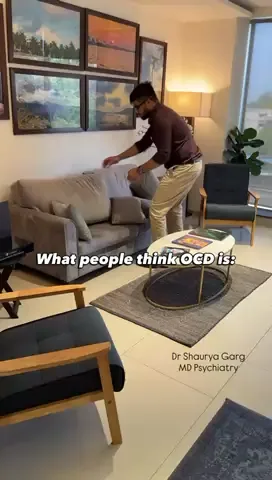
The opening scenes show the familiar stereotype: cleaning, arranging and trying to make things look exactly right. The later scenes show what OCD can actually feel like: obsessive doubt, repeated checking, counting, tapping and the return of a “what if” thought even after a task is complete.
Dr Garg returns to check a locked door, taps and counts to four without feeling satisfied, then continues to wonder on the road whether the door was closed. These are illustrations of an OCD cycle, not a diagnostic test.
The video above does not download until you select play. The Instagram video loads only when you select it. More on @dr.shaurya.garg.
In Delhi and Online
Where OCD treatment happens
In-person consultations take place at Annova Health, inside The Face Centre, 3rd Floor, 41 Ring Road, Block Q, Lajpat Nagar 4, New Delhi 110024, Monday to Saturday, 11 am to 7 pm, by appointment. The building is on Ring Road itself and is reached easily from Defence Colony, Jangpura, South Extension, Greater Kailash, East of Kailash, CR Park, Kalkaji and Nehru Place. Moolchand and Lajpat Nagar metro stations are both close by. Directions and a fuller clinic guide are on the Lajpat Nagar clinic page.
Where travelling to Delhi is not practical, OCD can be assessed and treated by secure video anywhere in India. ERP is a talking treatment and carries over to video well. What does not carry over is a first assessment where the picture is unclear or the risk is uncertain, and where that applies it is said plainly rather than worked around.
An in-person consultation is ₹3,000 for 30 minutes. Mon–Sat online consultations are ₹2,500 for 30 minutes, or ₹4,000 for a pre-booked 60 minutes. OCD is usually assessed across more than one appointment, because the presenting ritual is rarely the whole picture. Full details are on the fees page.
Common Questions
OCD questions, answered honestly
I like things clean and organised. Is that OCD?
Almost certainly not. Preferring order is a personality trait; you enjoy it and can leave it. OCD is unwanted, distressing, time-consuming, and interferes with life; the person performs rituals not because they enjoy them but because they cannot stop. The difference is suffering, not tidiness.
I have horrible thoughts about hurting people I love. Am I dangerous?
Unwanted, distressing harm thoughts are common in OCD and are not the same as intention. Their ego-dystonic quality often explains why they feel so frightening. A clinician should still assess intent, planning, history, insight and other symptoms individually rather than giving reassurance from one sentence alone.
What is ERP, and does it really work?
Exposure and response prevention gradually and collaboratively approaches feared triggers while reducing rituals. It helps a person learn that distress and uncertainty can be tolerated without compulsions. ERP has strong evidence for OCD and should be planned at an agreed pace, never imposed by force.
Will I need medication for OCD?
Not always. ERP may be used without medication for some presentations, while serotonergic antidepressants or combined treatment may be appropriate depending on severity, access, previous response, other conditions and preference. Dosing and duration are individual clinical decisions.
My family keeps reassuring me. Is that wrong?
It is understandable, and it maintains the OCD. Reassurance is a compulsion delivered by someone else: relief for minutes, reinforcement for years. Treatment includes helping families respond supportively without feeding the cycle.
Can OCD be treated online?
Online consultation can support assessment, ERP-informed planning and medication review for many people. Suitability depends on severity, safety, privacy, access to an appropriately trained therapist and whether in-person or local care is needed.
How much does OCD treatment cost in Delhi?
A consultation is ₹3,000 for 30 minutes in person in Lajpat Nagar, or ₹2,500 for 30 minutes online, Monday to Saturday, with a pre-booked 60-minute online session at ₹4,000. Sunday online sessions cost ₹5,000 for 30 minutes or ₹7,000 for 60 minutes, by prior arrangement. OCD is usually assessed across more than one appointment. Medication, where it is used, is bought separately at pharmacy rates, and therapy delivered by a clinical psychologist is charged by that clinician. Everything is stated before it starts, and the full fee list is published on the site.
Where in Delhi is the clinic?
Annova Health, inside The Face Centre, 3rd Floor, 41 Ring Road, Block Q, Lajpat Nagar 4, New Delhi 110024. The building is on Ring Road itself, a short drive from Defence Colony, South Extension, Greater Kailash and East of Kailash, with Moolchand and Lajpat Nagar metro stations both nearby. Consultations are Monday to Saturday, 11 am to 7 pm, by appointment.
Should I see a psychiatrist or a psychologist for OCD?
Either can be a reasonable starting point, and many people end up seeing both. A clinical psychologist delivers ERP, which is the core psychological treatment for OCD. A psychiatrist confirms the diagnosis, screens for the conditions that commonly sit alongside OCD, and can prescribe where medication is appropriate. If symptoms are severe, if there is significant depression, or if the picture is unclear, starting with a psychiatric assessment usually saves time.
How long does OCD treatment take?
There is no fixed course. ERP is usually measured in months rather than weeks. Where a serotonergic antidepressant is used, OCD generally needs higher doses and a longer trial than depression does before the effect can be judged fairly. Progress is tracked against agreed targets rather than a feeling of being finished, and anyone offering a guaranteed timeline is guessing.
Is ERP therapy available in Delhi?
Yes, though it is delivered less widely than general counselling, so it is worth asking a therapist directly whether they have been trained in ERP specifically rather than assuming it. Where ERP is indicated, the plan and the pace are agreed first, and treatment is coordinated with whoever delivers the therapy.
Dr. Shaurya Garg
Clinic Enquiries
Namaste. For appointment enquiries, you can message the clinic directly on WhatsApp. Conversations are private.